Tony and Maria meet at the dance
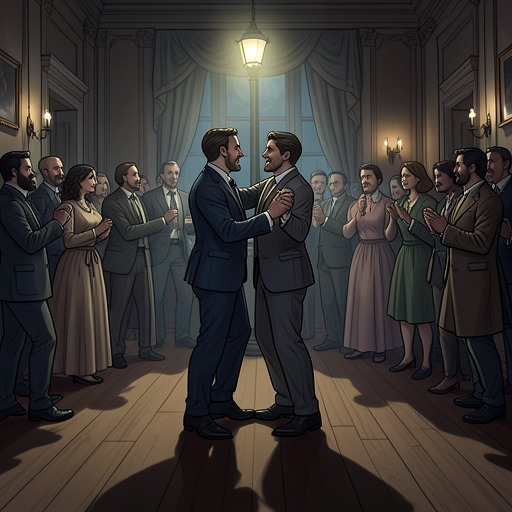
West Side StoryTony Wyzek and Maria Nunez meet at a neighborhood dance already charged with the possibility of violence. For Tony, the encounter transforms a room full of rival gangs and an evening he means to leave into an intimate, almost otherworldly connection; for Maria, it brings her brother Bernardo’s hostility directly into the new attraction. The meeting’s tenderness is brief, but its interruption makes clear how thoroughly personal desire is constrained by the conflict surrounding them.
A Dance on the Edge of Violence
The dance is not a neutral setting. Murray Benowitz sees the Jets gathering behind Riff Lorton, Action, and Tony, while the Sharks collect behind Bernardo. He fears the groups are about to fight where they stand. Two girls with the Jets have even taken off their shoes, ready to use their high heels as weapons. Murray calls for everyone’s attention and signals to a passing police officer that the situation is under control. When Officer Krupke arrives and gives orders, each gang forms a circle around its girls, and the dancers begin to move in opposing directions.
The orderliness is fragile. The two groups continue to stare at one another with hostility, and Murray’s effort to direct the evening depends in part on the presence of the police. Against this tense background, Tony’s appearance with the Jets does not signal that he feels at home among them. Although he arrives with Riff and Action, he feels out of place among both gangs. He has come without a partner; the others seem like strangers to him, and he considers slipping out unnoticed. Riff’s challenge to Bernardo, he thinks, is Riff’s concern. Tony’s attention is not yet fixed on the rivalry that has brought the groups into the same room.
Recognition and First Contact
That changes when Tony sees Maria leaning against a wall in a white dress. She notices him as well. The narration presents their mutual attention as immediate and absorbing: Tony approaches her, offers his hands, and is drawn away from thoughts of leaving. When a slower record follows the mambo, he takes her fingers gently and looks at her face. The white dress distinguishes Maria from the other girls around the dance floor, and Tony acknowledges that difference through a small nod of appreciation rather than a speech.
Their first dance is composed of careful, tentative gestures. Tony barely touches Maria’s back; she lays a light hand on his shoulder. As he turns her and holds her hand more firmly, she trembles. When she begins to draw away, he briefly tightens his fingers, then releases her. The pause and release matter: their closeness develops through touch, but Tony does not force the contact. The crowded, divided room recedes from his awareness, and the dance comes to feel like entry into a separate, gentle world.
The same transition continues away from the dance floor. With fireworks rising and forming hearts and stars, Tony impulsively kisses Maria’s palm when her hand comes near his mouth. He then leans close and kisses her lips, gently enough, as the narration describes it, not to violate the boundaries of their imagined world. The scene moves from a public dance, where the gangs’ hostility remains visible, to a private-seeming exchange made of glances and restrained touch. Its intensity is physical before it is explained: Maria trembles, and Tony responds to her presence rather than to the factional identities that have shaped the room.
Bernardo’s Intervention
A hand suddenly seizes Tony’s shoulder and nearly knocks him from the bench. Years of street fighting give him an immediate reflex: he springs upright with his fists ready. But he does not strike. He sees Bernardo looking past him at Maria, and the identity she has not yet disclosed becomes clear to him: she is Bernardo’s sister. The discovery changes the meaning of the encounter without undoing its mutual attraction. Tony has been drawn to Maria as an individual; the surrounding conflict recognizes her first as Bernardo’s family and Tony as one of the opposing gang.
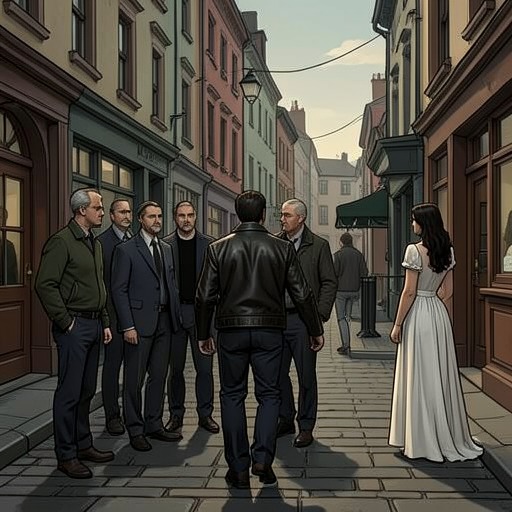
Bernardo orders Tony away from his sister and warns Maria that Tony belongs to the other side. Maria answers that she saw only Tony and that he had done nothing wrong. Her response sets her perception of the meeting against Bernardo’s demand that she interpret it through gang allegiance. Bernardo then takes Maria by the wrist and pulls her away. The physical tenderness that had defined her contact with Tony is abruptly replaced by her brother’s controlling grip, while Tony is left to confront the gulf between the connection he has just found and the hostility that immediately claims it.
From Meeting to Conflict
The interruption does not settle the tension; it sharpens it. Riff steps forward to address the conflict, and Bernardo later accepts the proposed duel between the gangs. The dance’s organized circles, Murray’s calls for attention, and the police presence have kept violence from breaking out inside the hall, but they have not reconciled the groups. Tony’s meeting with Maria takes place within that failure of public control: the same room that briefly permits intimacy also brings the lovers’ rival affiliations into direct contact.
The later knife fight gives the meeting a tragic consequence. Beneath the overpass, Tony tries to stop the fight, but Bernardo kills Riff; Tony then takes Riff’s knife and fatally wounds Bernardo. That outcome does not make the meeting a simple cause of the deaths: the rivalry and its rules are already in motion. It does, however, reveal the cruel proximity of the two strands of the story. At the dance, Tony and Maria’s attraction momentarily opens a space beyond the gangs; Bernardo’s intervention closes that space, and the violence surrounding them continues toward the deaths of both gang leaders. The encounter’s decisive significance lies in this contrast: tenderness appears not outside the conflict, but for an instant inside it.